Reducing stress through exercise is one of the most effective (and most underestimated) ways to restore your energy levels and mental balance. In Amsterdam, stress ranks as the number one health complaint. A packed schedule, work pressure, traffic, social obligations; it all adds up. Most people know that exercise helps, but never quite get around to it. Or they try, but notice little difference because they go about it the wrong way.
At Physicum, our personal training studio at the Vondelpark in Amsterdam Oud-Zuid, we work daily with people who, alongside their physical goals, are also dealing with stress, sleep problems or complete burnout. What we see time and again: those who exercise consistently and with purpose experience not only a stronger body, but a calmer mind.
What stress does to your body
Stress is not just a feeling. It is a physiological process in which your body produces cortisol and adrenaline – hormones that prepare you for action. In small doses, that is useful. But with chronic stress, your nervous system remains in overdrive continuously.
The effects are noticeable: you sleep worse, recover more slowly, lose concentration and your energy levels drop. Many people under chronic stress also change their eating habits, move less and find themselves caught in a downward spiral.
Exercise breaks that spiral, but only if you approach it the right way.
Why reducing stress through exercise works so well
Physical exercise demonstrably lowers cortisol levels in the blood. At the same time, it stimulates the production of endorphins, serotonin and dopamine — neurotransmitters that improve mood and promote relaxation.
But there is more to it. Exercise gives you a sense of control. You set a goal, you achieve it, you go home feeling like you have accomplished something. That sense of agency is precisely what people under stress so often lack.
Research shows that exercising at moderate intensity two to three times per week significantly reduces stress levels, with effects comparable to certain forms of therapy.
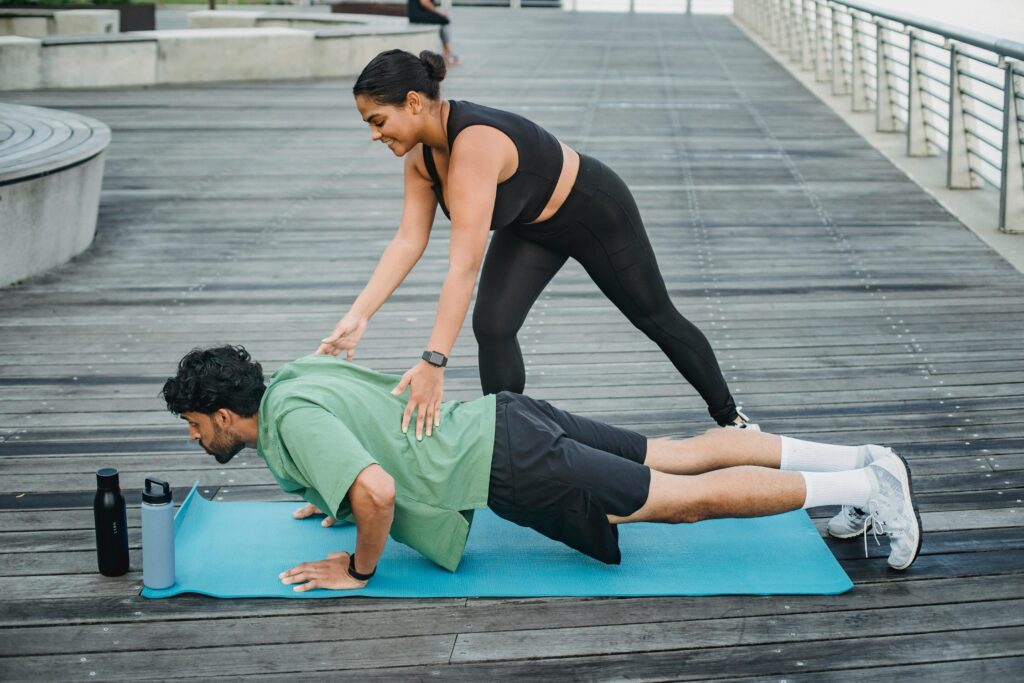
Why 1-on-1 guidance makes the difference
People dealing with stress have one thing in common: their heads are already full. Walking into a gym, figuring out which exercises to do, motivating yourself without anyone watching – all of that takes energy that simply is not there.
That is why 1-on-1 personal training is so much more effective for stress than going to the gym alone. You do not have to figure anything out. You show up, you train, you leave. Your trainer designs the programme, adjusts the intensity based on how you feel that day and takes your energy levels into account.
At Physicum, we always tailor training to what your body can handle at that moment. Had a tough week? We train differently than after a relaxed weekend. That way, exercise is never an extra stressor; it is always a release.
Jonas did it too: from exhausted to energised
Jonas (42) runs his own business in Amsterdam. Busy schedule, little sleep, always on. He started 1-on-1 personal training at Physicum twice a week, with guidance on both training and lifestyle.
After four weeks, he was sleeping better. Within two months, he felt calmer, had more energy and noticed a clear improvement in his productivity at work.
“I thought exercise would cost me time. It gave me energy I had not felt in years.”
Jonas still trains at Physicum.
Which type of training works best for stress?
Not all forms of exercise are equally effective for stress. These are the three most impactful:
Strength training
Strength training effectively lowers cortisol and builds self-confidence. It creates a feeling of strength and control that extends beyond the gym. At Physicum, strength training forms the foundation of almost every programme.
Low-intensity cardio
Walking, cycling or light jogging at low intensity activates the parasympathetic nervous system — the system that helps your body relax. Not sprinting, not pushing to exhaustion. Simply moving.
Mobility training and breathing
Tight muscles and shallow breathing are physical manifestations of stress. Targeted mobility and breathing exercises literally release tension from the body.
At Physicum, we combine all three based on what you personally need.

What to avoid when you are stressed
Intense exercise during periods of high stress can backfire. HIIT, heavy strength training without a proper build-up or training every day without recovery all raise cortisol levels further. Your body interprets intense exercise as an additional stressor.
We often see this with people who exercise out of guilt. They push too hard, feel even more exhausted afterwards and give up. That pattern is broken by a programme tailored to your specific situation, not to some average.
Nutrition and lifestyle: the missing link
Exercise alone is often not enough. Stress also affects what you eat, how you sleep and how you recover. At Physicum, we therefore guide you not only on training, but also on nutrition and lifestyle.
Practical adjustments, such as sufficient protein intake, reducing caffeine, drinking more water, a consistent sleep routine and mindful eating greatly amplify the effect of training. Small changes that together make a significant difference.
Frequently asked questions
- Does exercise really help with stress, or is that a myth?
No, it is not a myth. Dozens of studies confirm that regular physical activity lowers cortisol levels and stimulates the production of mood-enhancing neurotransmitters. The effect is strongest with consistent, moderate-intensity training. - How quickly will I notice a difference?
Most people notice an improvement in sleep quality and energy levels within two to three weeks. After six to eight weeks, the effects on mood and stress levels become measurable. - Can I exercise if I am experiencing burnout?
Yes, provided the training is adapted accordingly. At Physicum, a number of our trainers are also physiotherapists. They align the intensity with your recovery process. Exercise has been shown to be effective even during burnout, as long as the load remains appropriate. - How often do I need to train to reduce stress?
For most people, twice a week is enough to notice a meaningful effect. Consistency matters more than frequency. - What if I do not have time to exercise?
Sessions at Physicum are compact and efficient: 45 to 60 minutes, fully personalised. We work around your schedule, not the other way around. There is always a time that works for you.
How to get started
Physicum is located at Emmaplein 2 in Amsterdam Oud-Zuid, within walking distance of the Vondelpark. Open on weekdays from 07:00 to 22:00 and on weekends from 08:30 to 16:00.
Curious whether Physicum is right for you? Fill in the match test on our website and discover without any obligation what Physicum can do for you. We will get in touch to explore your goals together and explain how we can help. No commitments, just a good conversation.
Bronnen
- Li, X., Huang, J., & Zhu, F. (2025): The optimal exercise modality and dose for cortisol reduction in psychological distress: A systematic review and network meta-analysis. Sports, 13(12), 415
- Noetel, M., et al (2024): Effect of exercise for depression: Systematic review and network meta-analysis of randomised controlled trials
- Wipfli, B. M., Rethorst, C. D., & Landers, D. M. (2008): The anxiolytic effects of exercise: A meta-analysis of randomized trials and dose-response analysis. Journal of Sport and Exercise Psychology, 30(4), 392–410.